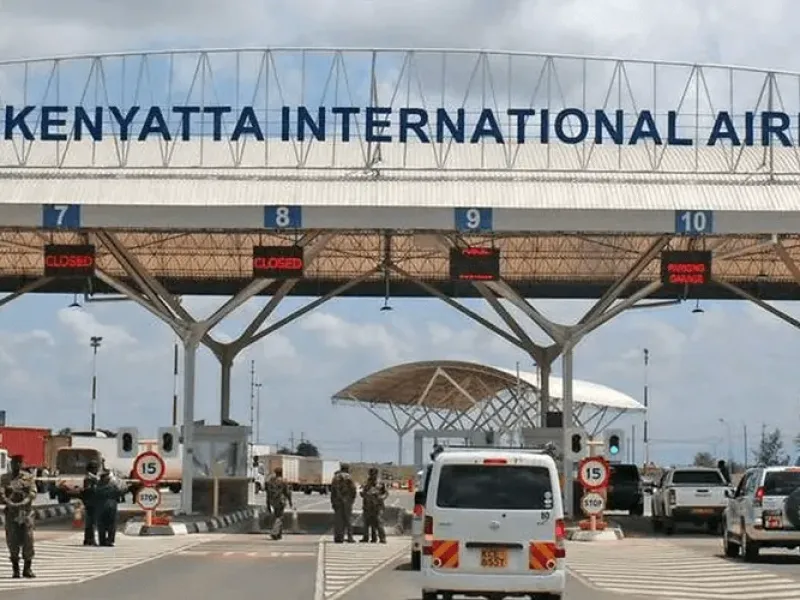
JKIA Tightens Terminal Access as Expansion Plan Kicks Off
If you're planning to drop someone off at Jomo Kenyatta International Airport (JKIA), get ready for some distraction in your usual routine.
The days of driving right into the inner terminal area to pick up and drop off friends and family are numbered - at least for as per the latest expansion plans. The change has been necessitated as part of a bigger plan to sort out congestion and make space for expansion on Kenya's busiest airport.
For years motorists have been driving directly into the terminal to pick up and drop off passengers - it was pretty convenient. But now that convenience is going to be scaled back to give space for the construction projects aimed at increasing the airport's passenger capacity.
What's Changing at JKIA ?
The upshot of the changes is that only airport taxis and licensed ride-sharing cars will be allowed into the main terminal's drop off area. Private cars on the other hand will have to use designated areas that will be located slightly further away next to the long term parking.
The move follows recommendations from Sidara, the firm that's been drawing up a long term master plan for JKIA's redevelopment. During stakeholder meetings they made it clear that temporary parking spots would be repurposed to allow for a bit more space for the airport to expand.
Their immediate goal is to increase the current capacity of 7.5 million passengers a year to around 12 million.
That is a pretty big leap - and it shows just how much pressure the airport is already under.
Terminals Struggling to Keep Up
JKIA's passenger numbers have been steadily rising but the airport's infrastructure hasn't always been able to keep up.
Terminal 1D which handles domestic flights, handled a whopping 1.8 million passengers last year, more than 3 times what it was originally designed for. That kind of strain has led to long queues, crowded waiting areas and delayed processing.
Terminal 1A which is used by Kenya Airways and its international partners is also running above capacity. Terminals 1B and 1C - used by other international airlines - have stayed a bit closer to their planned limits.
To correct this imbalances, airport planners are proposing structural shakeup.
Terminals 1B and 1C will be merged into a single bigger international departures area. International arrivals will move from Terminal 1E to Terminal 1A and 1E will close - freeing up space to expand Terminal 1D and take some of the pressure off domestic flights.
In simple terms, the airport is being reorganised to start working a bit more efficiently before the construction projects begin.
A Bigger Vision Beyond Just Parking
While the temporary restriction on private cars may be the most visible change, it's only a part of a much bigger plan to transform the airport.
The optimisation measures are just the first phase of a long term strategy to modernise JKIA. Plans include a brand new terminal, an extra runway and a whole new Airport City complete with a Special Economic Zone (SEZ).
If everything goes to plan, passenger numbers could rise to more than 22 million a year by 2029.
That would make JKIA an even more important regional aviation hub for Nairobi.
Digital Taxi System On The Horizon
The Kenya Airports Authority is putting the finishing touches on an airport ride-hailing system, aimed at making airport taxi trips safer and more straightforward.
Once the service is launched, passengers will be able to book a regulated taxi through the app, or in person at a terminal kiosk, and even at machines around the airport. The idea is to make it feel a bit less chaotic, with decent upfront pricing and live tracking of your ride. No more just turning up and hoping to find a taxi. The new platform aims to give you a bit more certainty in your airport travels.
What You'll Get Out of It
One of the clever aspects of this new platform is geofenced taxi ranks - which means the airport will be able to manage where these taxis can park and when they can get access to certain areas. It's not just about making things more convenient for you, but also keeping airport operations running smoothly.
Drivers wanting to be onboarded onto the new system will have to jump through some hoops first. They'll need a valid PSV licence, their ID, and all the details of their vehicle on file. Once they're on, the system will keep a close eye on how they're doing - their trip records, ratings and earnings - to make sure the service stays up to par.
What You Can Expect
Of course, change can be a bit of a drag at first. But the authorities reckon the long game here is a more efficient, more organised experience. It might take a bit of getting used to, and there might be a few bumps along the way. but if it all goes according to plan, we'll see a lot less congestion, shorter queues and a lot more comfy waiting areas.
Jomo Kenyatta International Airport is one of the busiest hubs in the region - and growing - so adapting to that is key. With this digital taxi system, they're trying to bring ground transport into the 21st century, and make things a lot more efficient.
Of course, how well it all works out will depend on how quickly everyone - passengers, drivers and airport staff - get used to the new way of doing things. It'll be a few months before we see how well this whole thing settles in.
And as for the old days of just pulling up where you pleased, those days are slowly coming to an end.
Recently Listed Vehicles
Browse all vehicles →
SINO/HOWO Howo Nx Tipper 2026 Diesel
KES7,865,000
Toyota Coaster 2010 Diesel
KES3,600,000

Toyota Corolla Fielder 2005 Petrol
KES800,000

Toyota Passo Moda 2016 Petrol
KES779,999